

Structural Concrete Restoration & CFRP Strengthening
Carbon fibre reinforcement. Engineer-specified. Installed from a sound substrate.
Overview
Concrete restoration and CFRP, explained.
Carbon fibre reinforced polymer (CFRP), also called carbon fiber reinforcement, combines high-strength fibres with a compatible resin. A structural engineer may specify it to strengthen suitable concrete beams, slabs or columns. Concrete restoration repairs the substrate; CFRP strengthening adds the designed reinforcement. They serve different purposes and may form part of the same rehabilitation scope.
We are the installation contractor. Structural assessment, calculations, reinforcement design, and acceptance criteria belong to the project's qualified structural engineer — our role is to execute the approved design with disciplined preparation and installation.
For general contractors, engineers, consultants, strata/property and facility managers, we coordinate access, concrete repairs, installation and inspection hold points. Based in Vancouver, serving all of British Columbia.
Typical applications
- Engineer-specified beam and slab strengthening in parking structures
- Column confinement where specified by the structural engineer
- Concrete rehabilitation in commercial, strata and institutional buildings
- Designed strengthening for changes in use or loading, subject to engineering assessment
- Specified seismic rehabilitation details; suitability determined by the engineer
Performance
What we weigh before recommending
- The engineering design governs orientation, extent, anchorage, and purpose of all reinforcement
- Substrate condition — reinforcement bonds only to sound, prepared concrete
- Access, shoring, and inspection requirements
- UV protection and specified fire protection are separate considerations; a decorative topcoat is not a fire-protection system
System options
CFRP reinforcement
Carbon fibre and compatible resin form external reinforcement that may be specified for strengthening beams, slabs, columns, and other elements. Orientation, extent, anchorage, and purpose follow the engineering design.
Anchored CFRP
Some designs incorporate fibre anchors to connect reinforcement to the substrate and address specified load-transfer and termination requirements. It is one established approach among several — not an exclusive method, and not always superior to bonded systems.
Concrete repair
Removal of unsuitable material, preparation, and compatible repair mortars restore the substrate before reinforcement is installed.
Installation
How the work runs
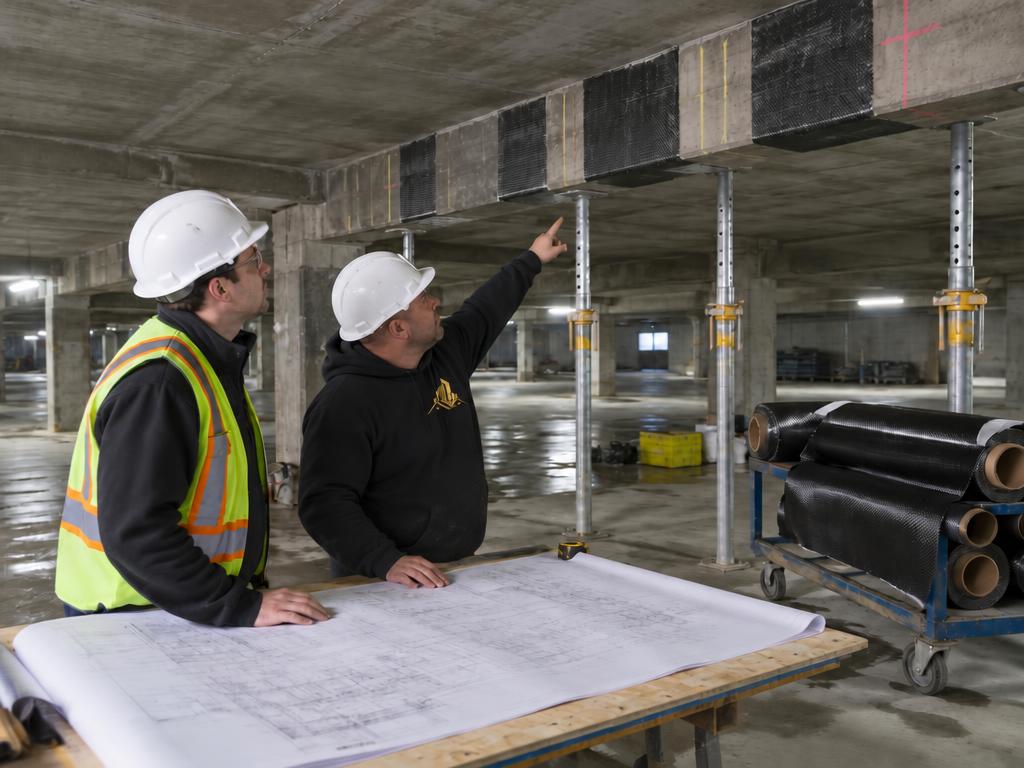
Review engineering drawings, the reinforcement system, substrate acceptance criteria, access, shoring responsibilities and inspection hold points with the project team.
Remove unsound material and complete compatible repairs. Mechanically prepare sound concrete and round corners where the reinforcement detail requires it; verify cleanliness and the specified substrate condition.
Confirm fibre orientation, limits, laps and termination details against approved drawings. Where anchors are specified, coordinate scanning and drilling; not every CFRP system uses anchors.
Apply the system's primer/putty and compatible resin as specified. Place fabric or bonded laminates in the approved orientation and consolidate to achieve contact and remove entrapped air, following the system requirements.
Install fibre anchors or other specified anchorage as part of the approved system detail and sequence. This stage applies only where the engineering design calls for it.
Maintain the specified curing conditions, document installation and coordinate required inspections/testing. Apply UV or fire protection only as specified, then hand over the maintenance and inspection requirements.
Preparation & detailing
- Substrate preparation and repair precede any reinforcement — bond depends on it
- Detection and drilling coordination before anchor installation
Maintenance & return to service
- Inspections follow the engineer's requirements for the structure
- UV and fire protection are maintained per the specified systems
Maintenance guide
Keep it looking new.
CFRP-strengthened elements need very little care; simple checks protect the system.
| Task | How often |
|---|---|
| Visual check of the CFRP and protective coating | As your engineer specifies |
| Clean with mild soap and water if needed | As needed |
Do
- Keep the protective topcoat intact
- Ask the engineer of record before any new drilling or attachment
Avoid
- Cut, drill or fix anything through the carbon fibre
- Expose the system to open flame or welding nearby
Related industries
- Strata & Multi-Residential
- Institutional & Public Facilities
- Manufacturing & Production
Questions
Structural Concrete Restoration & CFRP Strengthening FAQs


Start the conversation
Have a CFRP strengthening scope to discuss?
Tell us the location, affected elements, access constraints and timing. Include scope and specification details, and indicate whether engineering drawings are available. Mention documents in your description; we will arrange secure sharing.